

- Key Takeaways
- Why Key Management Matters
- Types of Cryptographic Keys
- How Key Management Works: The Key Lifecycle
- What Is a Key Management Service (KMS)?
- Key Management Best Practices
- Key Management and the Post-Quantum Transition
- How Encryption Consulting Helps
- Frequently Asked Questions
- Build Key Management That Actually Protects Your Data
Key management is the practice of securely handling cryptographic keys across their entire lifecycle, from generation and distribution through storage, rotation, and destruction. Because encryption is only as strong as the secrecy of its keys, key management is what keeps encrypted data actually protected.
Key management is the set of processes and standards for protecting cryptographic keys throughout their lifecycle: generating, distributing, storing, using, rotating, and destroying them securely, and controlling who can access them. Even the strongest encryption algorithm fails if its keys are poorly managed, so key management is the foundation of data security. It is commonly anchored in hardware security modules (HSMs) and key management systems.
Key Takeaways
- Key management is the secure handling of cryptographic keys across their full lifecycle, from generation to destruction.
- It is foundational: a strong algorithm provides no protection if its key is weak, exposed, or mismanaged. Poor key management, not weak algorithms, is the usual point of failure.
- The key lifecycle typically has eight stages: generation, distribution, use, storage, rotation, backup and recovery, revocation, and destruction.
- Keys should be stored in a hardware security module (HSM) or a key management system, protected by least privilege, separation of duties, and automation, and never hard-coded.
- Standards such as NIST guidance, FIPS, PCI DSS, and HIPAA set key management requirements, and keys are now also migrating toward post-quantum algorithms.
Why Key Management Matters
Cryptographic keys are the foundation of every security system. They encrypt and decrypt data, authenticate users, and secure data in transit. Because of that central role, a single compromised key can collapse an organization’s entire security posture: an attacker who steals a key can decrypt sensitive data, impersonate a trusted service, or gain access to other protected systems.
This is the crucial insight about encryption: it is only as strong as the protection around its keys. A perfectly implemented AES-256 cipher provides no security if its key is hard-coded in source code or stored in plaintext next to the data it protects. A stolen code signing key, for example, could let an attacker sign malware that systems trust as if it came from a legitimate vendor. Good key management is what turns a strong algorithm into real protection.
Types of Cryptographic Keys
Key management deals with two types of keys, which are used together in most real systems.
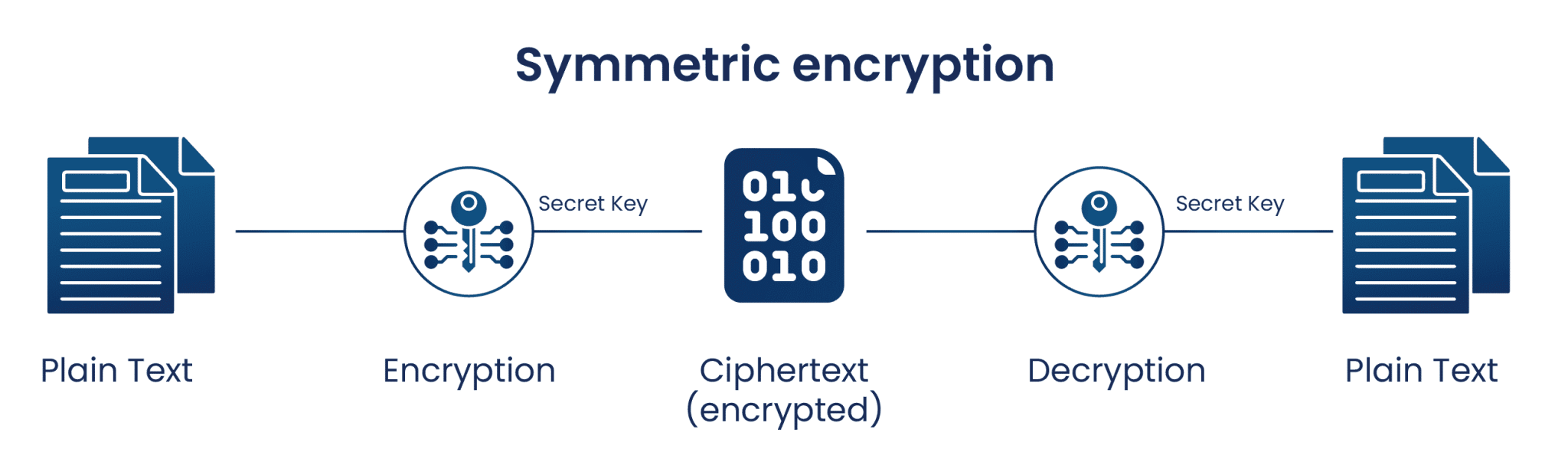
Symmetric keys
A symmetric key uses the same value to encrypt and decrypt data. It is fast and typically used for data at rest, such as records in a database: the data is encrypted with the symmetric key while stored, and decrypted with the same key when an authorized user needs it. The challenge is protecting and sharing that single key.
Asymmetric keys
Asymmetric cryptography uses a related pair of keys: a public key that can be shared freely and is used to encrypt, and a private key that must stay secret and is used to decrypt. Because the public key can be distributed openly, asymmetric keys are well suited to protecting data in transit across a network.
Most systems combine both. When sending sensitive data, the data is encrypted with a fast symmetric key; that symmetric key is then encrypted with the recipient’s public key and sent alongside the ciphertext; the recipient uses their private key to recover the symmetric key, then decrypts the data. This hybrid approach gives the speed of symmetric encryption with the secure key exchange of asymmetric encryption.
How Key Management Works: The Key Lifecycle
Key management follows a lifecycle that ensures each key is created, used, and retired securely. Most keys pass through eight stages.
| Stage | What happens |
|---|---|
| Generation | The key is created using a strong algorithm and a secure random source. A weak generator or insecure location compromises the key from the start. |
| Distribution | The key is delivered to authorized users or systems over a secure channel (such as TLS), to prevent interception in a man-in-the-middle attack. |
| Use | The key performs cryptographic operations, restricted to authorized users so it cannot be misused or copied. |
| Storage | The key is stored securely for later use, ideally in an HSM or cloud HSM rather than in application code or config files. |
| Rotation | When the key’s cryptoperiod (its usable lifetime) ends, or if compromise is suspected, data is re-encrypted under a new key and the old one retired. |
| Backup / Recovery | Keys are backed up securely so encrypted data is not lost if a key is unavailable. |
| Revocation | A key is marked unusable for encryption or decryption, even if its cryptoperiod has not expired, typically after suspected compromise. |
| Destruction | The key is permanently deleted from all stores so it cannot be recovered, except from a deliberately retained archive. |
Rotation matters because the longer a key is in use, the more exposure it accumulates and the more data it protects, so the more damaging its compromise would be. Destruction must be thorough, but NIST guidance requires that deactivated keys be kept in a secure archive, so that data encrypted in the past can still be decrypted later if needed. Balancing permanent destruction against the need to recover archived data is a core key management discipline.
What Is a Key Management Service (KMS)?
A Key Management Service (KMS) is key management offered as a service, letting an organization create and manage keys without operating the underlying hardware itself. Cloud providers offer KMS options that are effectively a cloud-based HSM: the provider manages the hardware while the customer retains control and access over their keys. This lets teams get strong key protection without the cost and operational burden of running their own on-premises HSM, though it introduces a dependency on the provider’s security and requires careful configuration of access controls.
Key Management Best Practices
Compliance standards and regulations, including NIST guidance, FIPS, PCI DSS, and HIPAA, expect organizations to follow established key management practices. The most important are:
- Never hard-code keys: A key written into source code, especially anything that might reach a repository, is instantly compromised. Anyone who can read the code can read the key.
- Apply least privilege: Give each user or system access only to the keys strictly necessary for their role. This limits exposure and narrows the suspect pool if a key is misused.
- Store keys in an HSM: Keep keys in a hardware security module (on-premises or cloud) so they are protected in tamper-resistant hardware rather than in software.
- Automate the lifecycle: Automate generation, rotation, backup, revocation, and destruction so keys do not silently exceed their cryptoperiod or get handled inconsistently.
- Create and enforce policies: Written key management policies give everyone a consistent procedure to follow and create an audit trail of who can access which keys.
- Separate duties: Split key management responsibilities across people, so that no single individual controls the whole lifecycle of a key (for example, separating who authorizes access, who distributes, and who generates keys).
- Split keys: For the most sensitive keys, divide the key into parts held by different people, so no one person knows the full key and multiple parties must cooperate to use it.
Key Management and the Post-Quantum Transition
Key management is central to the move to post-quantum cryptography. As organizations replace quantum-vulnerable algorithms such as RSA and elliptic-curve cryptography with NIST’s post-quantum standards like ML-KEM (FIPS 203) and ML-DSA (FIPS 204), they must generate, store, and manage new types of keys, often alongside classical keys in hybrid deployments during the transition. This makes crypto-agility, the ability to change algorithms and keys without re-engineering systems, a key management priority. A sound key management foundation is what makes a smooth post-quantum migration possible. See EC’s post-quantum cryptography resources for more.
How Encryption Consulting Helps
Key management is where encryption strategies most often succeed or fail, and it is genuinely hard to do well across a large organization. Encryption Consulting’s Encryption Advisory Services help assess your current key management, design a strategy and architecture aligned to NIST, FIPS, PCI DSS, and HIPAA requirements, and implement sound practices including HSM-backed storage, automated key lifecycle management, and separation of duties. We also help prepare key management for shorter certificate lifetimes and the post-quantum transition. Backed by ISO/IEC 27001:2022 and SOC 2 certified practices.
Frequently Asked Questions
What is key management in simple terms?
Key management is how an organization safely handles its cryptographic keys, the secret values that lock and unlock encrypted data, throughout their whole life: creating them, sharing them securely, storing them, rotating them, and destroying them when done. Because encrypted data can only be protected if its keys are protected, key management is what makes encryption actually work in practice. It is often compared to managing the keys to a building’s locks.
Why is key management important?
Key management is important because encryption is only as strong as the protection around its keys. Even an unbreakable algorithm provides no security if its key is stolen, exposed, or poorly stored. A single compromised key can let an attacker decrypt sensitive data, impersonate a trusted system, or sign malicious software. In practice, most encryption failures come from weak key management, not weak algorithms, which is why it is treated as foundational to data security.
What are the stages of the key lifecycle?
The key lifecycle typically has eight stages: generation (creating the key securely), distribution (delivering it over a secure channel), use (performing cryptographic operations), storage (keeping it safe, ideally in an HSM), rotation (replacing it when its cryptoperiod ends), backup and recovery (so data is not lost), revocation (marking it unusable if compromised), and destruction (permanently deleting it). Managing each stage securely is what key management is about.
What is the difference between key management and a KMS?
Key management is the overall practice of securely handling cryptographic keys across their lifecycle. A Key Management Service (KMS) is a specific tool or service that performs key management for you, often cloud-based, so you can create and manage keys without operating the underlying hardware. Cloud KMS offerings act like a managed cloud HSM: the provider runs the hardware while you keep control of your keys. A KMS is one way to implement good key management.
Where should cryptographic keys be stored?
Cryptographic keys should be stored in a hardware security module (HSM) or a cloud HSM, where they are protected in tamper-resistant hardware and never exposed in plaintext. Keys should never be hard-coded into source code, stored in configuration files, or kept alongside the data they protect. For cloud workloads, a cloud provider’s key management service can store keys securely. The goal is to keep keys isolated, access-controlled, and auditable.
What are the best practices for key management?
Core best practices are: never hard-code keys; apply least privilege so users access only the keys they need; store keys in an HSM; automate the key lifecycle so keys are rotated and retired on schedule; create and enforce written key management policies; separate duties so no one person controls a key’s whole lifecycle; and split highly sensitive keys among multiple people. Together these align with NIST, FIPS, PCI DSS, and HIPAA requirements.
Build Key Management That Actually Protects Your Data
Strong encryption depends entirely on strong key management, and getting it right across an organization takes strategy, the right tools, and sound process. Explore Encryption Consulting’s Encryption Advisory Services to assess and strengthen your key management aligned to NIST and industry standards.
- Key Takeaways
- Why Key Management Matters
- Types of Cryptographic Keys
- How Key Management Works: The Key Lifecycle
- What Is a Key Management Service (KMS)?
- Key Management Best Practices
- Key Management and the Post-Quantum Transition
- How Encryption Consulting Helps
- Frequently Asked Questions
- Build Key Management That Actually Protects Your Data